Does it feel like everyone is talking about the future of artificial intelligence (AI) in hospitality? If it does, you're not wrong. According to our AI in the Hospitality Industry report, 71% of hoteliers believe AI will have a significant or transformative impact on the industry. That's a lot of hospitality professionals anticipating that artificial intelligence will bring big change.
The future of AI in the hospitality industry is bright, but as we see it, AI is already making a major splash: 82% of hoteliers plan to expand their use of AI within the next year and 85% expect to allocate at least 5% of their IT budget to AI tools in 2026.
Key highlights:
AI technology in the hospitality industry is the use of artificial intelligence to automate hotel operations, personalize guest experiences and improve efficiency across the guest journey.
The most common use cases include AI-powered guest messaging, virtual concierge, translation, predictive maintenance, fraud detection and personalized marketing.
Hoteliers using AI report saving staff time, higher guest satisfaction, automated workflows and increased revenue, per Canary's 2026 research.
Canary's hospitality-specific AI platform powers guest communication, upsells and voice automation across the entire stay, trusted by more than 20,000 hoteliers.
Let's explore the five best use cases for AI in the hospitality industry and break down how they are improving hotel operations and the guest experience.
1. Personalized Guest Experiences at Scale
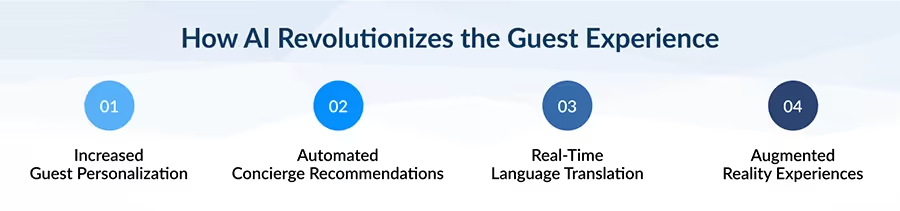
Hoteliers are always looking for ways to improve the guest experience, and embracing AI is one of the most efficient ways to do this at scale. Where personalized service used to mean handwritten notes and a good memory at the front desk, it’s now about delivering the same warm touch to every guest in their preferred language on the platform they use. Here's how artificial intelligence tools enhance the entire traveler journey.
Personalized Guest Experiences
Personalized touches transform stays for the better, but have historically been difficult to scale. With AI-powered personalization, hoteliers can establish better relationships with their guests.
AI-enabled guest messaging gives hotels the ability to send targeted communications to guests, including tailored upsell offers, routine messages to solicit feedback and personalized recommendations without increasing staff workload.
Virtual Concierge Services
Did you know that, according to research by Oracle, 73% of travelers prefer to stay at hotels that offer self-service technology? AI-powered tools are the perfect way to cater to these travelers.
Tools like AI Webchat help guests book with your property, answering questions in seconds. Once guests have begun their stay, an AI-powered virtual concierge provides a 24/7 extension of your in-person services. That includes handling early check-in requests, recommending a nearby restaurant that fits a guest's dietary preferences, booking a spa treatment, ordering room service and pointing out that the pool bar closes at 9 p.m. And it happens across text, WhatsApp or webchat, whichever the guest prefers.
Real-Time Translation and Multilingual Support
Difficulties communicating with travelers who speak other languages are a thing of the past thanks to the multilingual capabilities of AI communication tools.
With real-time AI-powered translation, your front desk team can talk to guests in their native language with ease. This perk establishes your hotel as an accommodating destination for global travelers by providing excellent service to everyone.
Augmented Reality (AR) Integration
Smart glasses and headsets have brought AR to the mainstream, and integrating this tech with AI provides a new take on the guest experience in several ways.
By using AR, hotels can offer virtual tours and interactive features that guests can access via smartphones or AR glasses. Travelers can immerse themselves in interactive guides, virtual property tours, concierge services and more all from the comfort of their rooms.
Predictive AI is software that spots patterns in historical data and uses them to forecast what's coming next. Instead of reacting to a sold-out weekend or a burst pipe, hotels get advance warning and time to plan. That means better staffing decisions, fewer surprise maintenance bills and rooms priced right for actual demand. Here's how hoteliers are putting this predictive power to work.
Demand Forecasting
Accurate demand forecasting — the practice of analyzing trends and making predictions about booking demands — is one of the more important hotel performance indicators. And by using AI tools, hoteliers take the guesswork out of the equation for even more accurate forecasting.
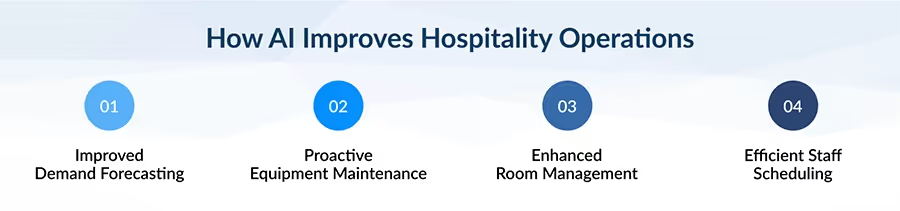
An advantage of AI technology is its ability to effectively analyze patterns in historical data, market trends, event-related spikes and more. In turn, hoteliers make more informed predictions in a fraction of the time, staying well ahead of the booking curve.
Hotel Equipment Maintenance
The equipment your hotel relies on, such as air conditioners, heaters, pool pumps and landscaping tools, is vital to maintain. Managing this is a complex job but it's one made easier by AI.
AI tools trained to accurately monitor usage keep track of maintenance schedules and make intelligent recommendations about when components need to be replaced. Knowing what to fix before it breaks means fewer service interruptions.
Smart Hotel Room Management
Smart home devices are the norm in many households. Make sure guests have the comforts of home when they travel by modernizing hotel rooms with smart devices.
AI-powered smart devices control temperature, lighting, entertainment systems and more. These devices create a more comfortable stay for guests and increase your hotel's environmental sustainability.
Efficient Staff Scheduling
Just as AI can be helpful in demand forecasting, it can use those same insights to create more efficient scheduling systems that benefit both hoteliers and their staff.
By analyzing booking trends, team availability and employee preferences, AI enables hotels to create schedules that are evenly distributed between maximum efficiency and employee satisfaction.
3. Stronger Payment Security and Fraud Detection
Hotels handle a lot of sensitive data every day, from credit card numbers to passport scans. Every one of those touchpoints is a target. AI-driven security tools reduce human error, catch suspicious patterns and free your team from constant manual monitoring. The result: guest data stays safer, chargebacks drop and your team spends more time on hospitality than on incident reports.
Facial Recognition Systems
Most of us are familiar with facial recognition because of how we unlock our smartphones, but this technology can also power hotel security operations.
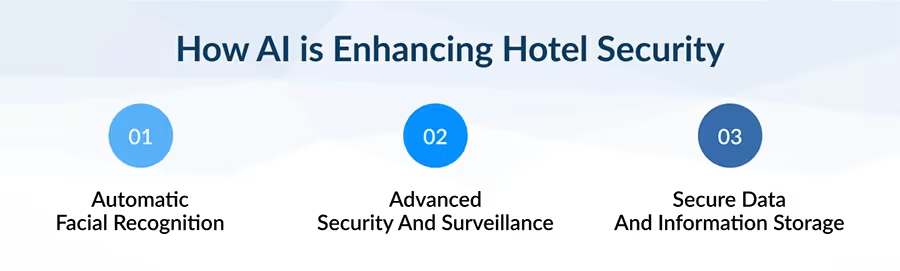
Facial recognition systems powered by AI provide both enhanced security and convenience for guests. It streamlines check-in, checkout and any on-site purchases and also provides a more secure way to grant access privileges to guests and staff.
Security and Surveillance
Safety is a non-negotiable for any hotel, but investing in the equipment and employee power to facilitate this can quickly eat away at your operational budget.
AI gives security tools the power to enhance manual, human-led practices with automation. AI can handle monitoring security footage, suspicious access activity and more, intelligently identifying where human review might be needed.
Data Protection and Privacy Compliance
AI's primary role is to collect, process and store data with remarkable efficiency and security. For hotels, this means sensitive guest information, such as credit card details and personal data, can be handled without human involvement.
By eliminating the risk of human error, AI creates a safer, more reliable system for managing and safeguarding critical information, ensuring a secure environment for both guests and businesses.
4. Automated Guest Communication Across Channels
Good communication leads to happier guests. But guests today reach out on whatever channel is closest at hand: texting on the way to the airport, webchatting on the hotel restaurant menu, a phone call from the room. Answering all of them in every language at any hour used to require an army. AI now handles the volume so your team can handle the moments that matter. From answering questions to soliciting feedback, here's how AI helps hotels do this at scale.
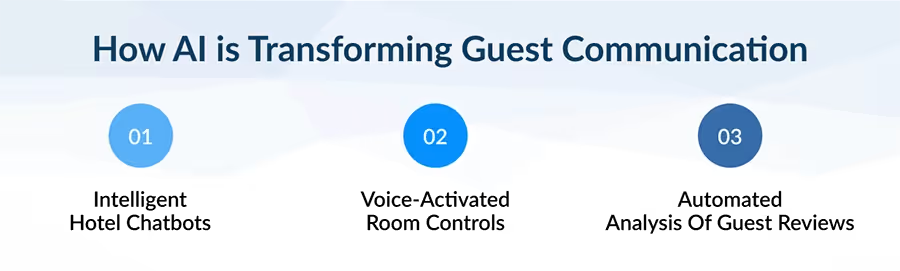
AI Hotel Chatbots
Sometimes, guests have a lot of questions and responding to inquiries is often the most time-consuming activity your staff has on their plate. But AI chatbots and voice assistants offer a way to reduce the front desk's workload without sacrificing service.
Webchat agents give potential guests answers on your website automatically, while AI voice assistants handle inbound calls with ease. Once a reservation is made, guest messaging automatically handles guest inquiries from post-booking to post-stay.
Voice-Activated Room Controls
From phones to smart speakers, many people consider voice assistants to be integral to their lives, both at home and when they travel.
When hotels incorporate these voice-activated room controls with AI, guests can experience in-room convenience in the most modern way. Travelers can easily request housekeeping, room service or adjustments to the room's environment, and AI can learn to anticipate these needs.
AI-Driven Guest Feedback Analysis
Across e-commerce platforms, product reviews are getting aggregated into AI summaries, and this technological transformation is coming to the hospitality business as well.
AI tools analyze guest feedback and give hotels actionable insights in a scalable way, which isn't possible through manual reviews. With AI, hotels get actionable insights in seconds with a concise, summarized overview of guest feedback.
5. Targeted Upsells and Hospitality Marketing
Potential guests are out there, and reaching them through marketing is necessary for making a connection. Every hotel is fighting for attention in the same crowded inbox, and generic email blasts don't cut through anymore. AI changes the math: it studies your guest data, spots the patterns a human marketer would need weeks to find and turns those patterns into offers guests actually want to click. This is being made easier with the power of AI. Here's what that looks like across the marketing funnel.
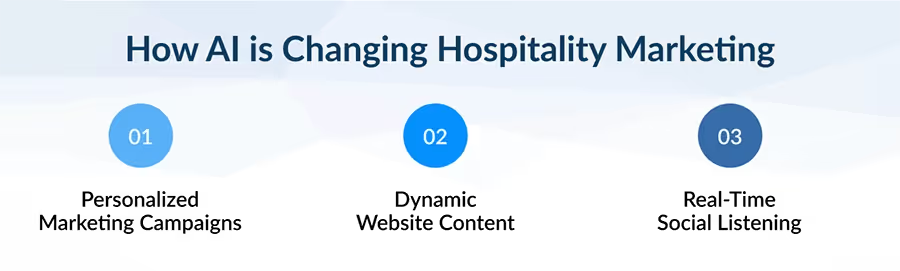
Personalized Marketing
Personalized marketing based on guest personas is something many hotels are already familiar with, but AI can make the task much easier.
Because AI algorithms are so good at analytics, they are able to quickly study the pieces of guest data that can inform a personalized campaign. Harnessing the power of information like browsing habits, loyalty status and travel preferences lets hotels offer tailored, customized promotions without any guesswork.
Dynamic Content Generation
Hotels have long had to consider their search engine ranking to get in front of potential travelers, but now that AI-generated travel planning is on the rise, having informative content is more important than ever before.
AI writing tools are a great way for hoteliers to create the kind of content that travelers want to see. From sharing details about your amenities to highlighting local attractions, automated content lets hotels answer guest questions at scale.
Real-Time Social Listening
Social listening is the practice of monitoring online conversations for mentions of your brand. It's useful but it's often low on the priority list for hotels due to how much time it consumes.
AI automates the process, providing all the insights you need on traveler sentiment. AI-powered tools scan social media, delivering aggregated information for quick understanding.
Stay Up to Date with AI Trends in Hospitality with Canary
For busy hoteliers, keeping up with the innovations in the hospitality industry can feel like a job in itself. The next wave of hospitality AI is agentic solutions that don't just suggest an action but complete it, like rebooking a room or dispatching housekeeping automatically, without staff in the loop. At Canary, we're always keeping tabs on these latest innovations and bringing you the tools your hotel needs to stay ahead of the curve.
Answer questions from current and future guests at scale
Communicate in 100+ languages automatically
Want to see Canary AI in action? Request a demo today to learn more.
Frequently Asked Questions
What is AI technology in the hospitality industry?
AI technology in the hospitality industry is software that uses machine learning and natural language processing to automate guest communication, personalize service, predict demand and protect payment data. Instead of replacing your team, it takes repetitive work off their plate so they can focus on the interactions that guests remember.
Artificial intelligence in hotels examples include:
AI guest messaging that answers questions in seconds over text, WhatsApp and webchat
Voice AI that handles inbound calls and routes urgent ones to the front desk
Predictive analytics for demand forecasting, equipment maintenance and staff scheduling
Facial recognition and fraud detection that protects guest data and reduces chargebacks
Personalized upsell and marketing campaigns built from real guest data
What are the biggest AI innovations in the hospitality industry?
The biggest AI innovations in the hospitality industry today are conversational AI (across voice, text and webchat), agentic AI that completes multi-step tasks on its own and predictive tools that forecast demand and maintenance needs.
Each one has moved from experiment to production over the last two years, and Canary's 2026 research shows 82% of hoteliers plan to expand their use of AI within the next year. If you're mapping innovation in hospitality industry priorities for 2026, this is where the fastest returns are showing up.
How hard is it to implement AI in hotels and train staff to use it?
Implementing AI in hotels is easier than most teams expect, but the use of AI in hospitality industry processes still runs into three real challenges: choosing tools that integrate with your existing PMS, getting clean data into the system and helping staff trust the AI's outputs. The last one is the most challenging — if your team treats AI like a threat, they'll route around it. If they treat it like a colleague that needs onboarding, they'll get real value from it. Invest in hotel staff training that covers when to trust the AI, when to escalate and how to give it feedback.
Here's how to implement AI in your hotel:
Start with one high-volume workflow, like guest messaging or webchat, so you can measure impact quickly
Pick a vendor with proven PMS integrations so you're not stuck with data silos on day one
Train the AI on your property's actual policies, amenities and voice, not generic templates
Run a two-week pilot with a small team before rolling out across the property
Set clear escalation rules so guests always have a fast path to a human when they need one
What are the most impactful use cases of AI in the hospitality industry?
The most impactful AI use cases in hospitality are the ones that touch the guest journey directly and repeatedly: AI guest messaging, AI-powered upsells and conversational AI for pre-arrival questions. These use cases combine high volume, quick wins and clear ROI, which is why they show up first in most hotel AI roadmaps.
What hotel operations can AI fully automate today?
Today, AI can fully automate a set of well-defined, high-frequency tasks: answering routine guest questions across text, chat and voice, sending pre-arrival and post-stay messages, routing service requests to the right department, presenting personalized upsells at check-in and summarizing guest feedback.
More complex work still needs a human in the loop, but the volume of tasks AI handles end-to-end is growing fast. For a broader view, see our guide to hotel automation benefits.
How do I evaluate the top hotel tech companies with AI automation features?
When comparing vendors for artificial intelligence in the hospitality industry, focus on four things: whether the AI is built specifically for hotels or bolted onto a generic chatbot, how deep the PMS integrations go, what security certifications the vendor holds (PCI Level 1 is the benchmark) and how easily the AI can be trained on your property's specific policies and voice.
Ask for references from properties similar to yours in size and segment, and always ask to see the vendor's approach to escalation and human handoff.
What are the best AI tools for hotel front desk automation?
The best AI tools for hotel front desk automation are those that reduce lobby queues, cut incoming call volume and route requests to the right team without extra clicks.
That typically means mobile check-in, AI voice for inbound calls, AI webchat for the website and AI guest messaging via text and WhatsApp. Together, they take the top three time drains off your front desk agents' plate: answering the phone, answering the same questions and handing over key cards.








.avif)

